


PROCESSING...

Anti-Money Laundering
Consulting Services & Strategies

0 Items - Total: $0.00 CAD

Proposed 2023 AML Changes: Mortgage Lenders and Armoured Car Services

Background

February seems to be the month for proposed legislative changes.

On February 18, 2023, draft amendments to the regulations under the Proceeds of Crime Money Laundering and Terrorist Financing Act (PCMLTFA), and a net-new draft regulation, were published in the Canada Gazette. If you’re the type that likes to read original legislative text, you can find it here. We (thanks Rodney) also created a redlined version of the regulations, with new content showing as tracked changes, which can be found here.

These changes are meant to renew and improve Canada’s anti-money laundering (AML) and anti-Terrorist Financing (ATF) regime, adapting to new money laundering (ML) and terrorist financing (TF) risk. One of the most significant changes, in our opinion, is the introduction of two new regulated entity types, mortgage lenders and armoured car companies.

Currently, mortgages issued by financial entities are captured under the PCMLTFA but these amendments would make all entities involved in the mortgage lending process (brokers responsible for mortgage origination, lenders responsible for underwriting the loan, and administrators responsible for servicing the loan) reporting entities. The intent here is to level the playing field between regulated and unregulated mortgage lenders, and to deter misuse of the sector for illicit activities.

While the activity of transportation is not currently supervised for AML purposes per se, armoured car carriers provide services largely to regulated entities. Given the flow of funds that is typically seen in this sector, reconciliation and identification of the origin of funds can sometimes be challenging, and allows funds to move with some degree of anonymity, which is an ML/TF vulnerability.

The draft regulations also introduce new requirements for correspondent banking relationships, and additional requirements related to the Money Services Business (MSB) registration. There are also some technical amendments related to existing reporting requirements and changes related to Administrative Monetary Penalties (AMPs).

Lastly, a new regulation would introduce a prescribed formula for the Financial Transactions and Reports Analysis Centre of Canada (FINTRAC) to assess the expenses it incurs in the administration of the PCMLTFA against reporting entities. Such models are seen from other regulators, such as the Office of the Superintendent of Financial Institutions (OSFI) and the Financial Consumer Agency of Canada (FCAC). Currently, FINTRAC is funded through appropriations.

In the following sections, we have summarized what we feel are the most important requirements to note.

Armoured Car Companies

The proposed changes would require a company that engages in “transporting currency or money orders, traveller’s cheques or other similar negotiable instruments” (except for cheques payable to a named person or entity) to be considered an MSB. As such, the following obligations will have to be met:

  • Development of a compliance program;
  • Maintaining an up-to-date MSB registration with FINTRAC;
  • Conducting compliance effectiveness reviews;
  • Reporting certain transactions;
  • Identifying customers;
  • Record keeping;
  • Risk ranking customers and business relationships;
  • Conducting transaction monitoring and list screening;
  • Conducting enhanced due diligence and transaction monitoring for high-risk customers and business relationships; and
  • Follow ministerial directives and transaction restrictions.

One record keeping obligation to note, which is new for armoured car companies, is the requirement to record the following information when transporting CAD 1,000 or more of cash or virtual currency, or CAD 3,000 or more in money orders or similar negotiable instruments:

  • The date and location of collection and delivery;
  • The type and amount of cash, virtual currency or negotiable instrument transported;
  • The name and address of the person or entity that made the request, the nature of their principal business/occupation and, in the case of an individual, their date of birth;
  • The name and address, if known, of each beneficiary;
  • The number of every account affected by the transport, the type of account, and the name of the account holder;
  • Every reference number that is connected to the transport, and has a function; equivalent to that of an account number; and
  • The method of remittance.

An additional requirement that will apply to armoured car companies is in relation to PEP determinations (existing PEP requirements for MSBs still apply). Specifically, a PEP determination is required whenever a person requests that the MSB transport more than CAD 100,000 in cash or virtual currency, or in an amount that is not declared.

Under the proposed regulations, there are some exemptions for reporting that are noteworthy. Large Cash and Large Virtual Currency reporting requirements will not apply where there is an agreement of transportation between:

  • The Bank of Canada and a person or entity in Canada;
  • Two financial entities;
  • Two places of business of the same person or entity; or
  • Canadian currency coins for purposes of delivery under the Royal Canadian Mint.

It is noteworthy, based on the definition, that there may be more than just armoured car companies that are captured under these new requirements. This will be clarified in guidance from FINTRAC that will follow publication of the legislation.

The requirements applicable to armoured car companies will come into force eight months after final publication in the Canada Gazette.

Mortgage Lending

The proposed regulations would require mortgage lenders, brokers, and administrators (mortgage participants) to put in place compliance regimes, similar to that of other regulated entities, which include the following:

  • Development of a compliance program;
  • Conducting compliance effectiveness reviews;
  • Reporting certain transactions;
  • Identifying customers;
  • Keeping records;
  • Risk ranking customers and business relationships;
  • Conducting transaction monitoring and list screening;
  • Conducting enhanced due diligence and transaction monitoring for high-risk customers and business relationships; and
  • Follow ministerial directives and transaction restrictions.

It is noteworthy, that many mortgage brokers already have existing voluntary AML compliance programs and already apply AML measures. This is in part due to various securities regulations and lending partners.

The requirements applicable to mortgage lending will come into force six months after final publication in the Canada Gazette.

Cost Recovery

As part of this round of regulatory changes, there is a net-new regulation, the Financial Transactions and Reports Analysis Centre of Canada Assessment of Expenses Regulations. This regulation will allow FINTRAC to pass on expenses, to reporting entities, that it incurs in the administration of the PCMLTFA. Only the following prescribed entity types are affected by this:

  • Banks and authorized foreign banks;
  • Life insurance companies;
  • Trust and loan corporations; and
  • Every entity that made more than 500 threshold reports during the previous fiscal year.

The regulations provide a formula that FINTRAC would use to calculate the assessment amounts payable by reporting entities on the basis of their annual asset value, and the volume of all threshold transaction reports submitted. For clarity, threshold transaction reports include Large Cash Transaction Reports (LCTRs), Large Virtual Currency Transaction Reports (LVCTRs), Electronic Funds Transfer Reports (EFTRs), and Casino Disbursement Reports (CDRs).

The requirement would come into force on April 1, 2024. This means FINTRAC would commence recovering costs from the 2024-2025 fiscal year and forward.

Other Changes

Enhancing MSB registration

Under the proposed amendments, as part of MSB registration, MSBs would now need to include the telephone numbers and email addresses of its president, directors and every person who owns or controls 20% or more of the MSB. This is in addition to current required information. Additionally, the number of the MSB’s agents, mandataries and branches in each country will be added (currently, only those within Canada are required).

This requirement will come into force twelve months after final publication in the Canada Gazette.

Streamlining requirements for sending AMPs

Under the proposed amendments, FINTRAC would be allowed to serve a reporting entity solely by electronic means when issuing an AMP. Currently, FINTRAC would also have to send an additional copy by registered mail.

This requirement would come into force on registration.

What Next?

There is a 30 day comment period (ending March 20, 2023) for the proposed regulations. It is strongly recommended that industry, and potentially impacted companies, review carefully and provide feedback. Comments can be submitted online via the commenting feature after each section of the proposed changes, or via email directly to Julien Brazeau, Associate Assistant Deputy Minister, Financial Sector Policy Branch, Department of Finance, 90 Elgin Street, Ottawa, Ontario K1A 0G5.

We’re Here To Help

If you have questions related to the proposed changes, or need help starting to plan, you can get in touch using the online form on our website, by emailing us directly at info@outliercompliance.com, or by calling us toll-free at 1-844-919-1623.

Suspicious Transaction Reporting Updates

FINTRAC has published updated resources related to upcoming changes to suspicious transaction reports (STRs) on its Draft Documents page. This includes updated draft guidance on STRs, expected to come into force in September 2023.

While the updated forms are not yet in use, it is important that you communicate these changes to your information technology (IT) teams and service providers. The documentation published this week includes JSON schemas and API endpoints.

For reporting entities that complete STR reporting manually through FINTRAC’s online reporting portal, it is also important to familiarize yourself with updated structured reporting fields, including:

  • URL,
  • Type of device used,
  • Username,
  • Device identifier number,
  • Internet protocol address, and
  • Date and time in which online session request was made.

These can be reviewed in the draft STR form.

Of course, if you require assistance, Outlier Compliance is here to help, please contact us.

New Terrorist Financing Indicators

FINTRAC has published updated indicators related to terrorist activity financing.

These are subdivided into three broad types of violent extremism:

  • religiously motivated violent extremism (RMVE),
  • politically motivated violent extremism (PMVE), and
  • ideologically motivated violent extremism (IMVE).

Each subtype has distinct characteristics and indicators. While it can be tempting to think that these types of things don’t happen here, unfortunately, they can and do happen here in Canada. As a Compliance Officer, it’s important to think through where these indicators might be visible to you and your team.

All Canadian reporting entities must use this information to:

  • Update the indicators in training materials,
  • Update the indicators in policies and procedures, and
  • Update transaction monitoring mechanisms (where applicable) to detect relevant indicators.

Of course, if you require assistance, Outlier Compliance is here to help, please contact us

Information Should Be Free!

Outlier has produced an open-source AML and ATF, and Privacy repositories of definitions, acronyms, and terminology that is free for whoever wants it.

Please feel free to provide contributions and/or feedback, as it would be greatly appreciated. We have already had three contributors!

Discombobulated

About a year ago, we had a client who was interacting with the world of Anti-Money Laundering (AML) and Anti-Terrorist Financing (ATF) for the first time. They were aggravated by the amount of jargon, acronyms, and uncommon uses of certain commonly understood terms. An example is, a business relationship. Those of you that are relatively familiar with the AML space know a business relationship doesn’t mean what the rest of the world thinks it means. In Canada, in the AML context, it means something very different.

A Helping Hand

At the time, they wished for a simple reference point where they could easily find the meaning for different terms. Unfortunately, this entails combing multiple locations, including FINTRAC’s website, plus the Act and Regulations themselves. To make a long story short, there is no easy way. Fed up, they (not so) gently suggested that we (Outlier) fix this. Their idea was creating a GitHub repository.

For those unfamiliar with GitHub, it is a web-based hosting service for version control. It is mostly used for computer code, but has also been used to write and edit books. It offers access control and several collaboration features. A GitHub repository is where the code and/or information is maintained for a specific project. This process is fairly simple to someone who is a coder with years of experience working with GitHub. For myself, this was not so simple. A year later, almost to the day, the repository is created, open and available to the public. There is no need to be scared, you are able to comment and make suggestions without knowing how to code at all. If you can’t figure out how to provide commentary in GitHub, send it to use via email at info@outliercompliance.com with the subject line “GitHub Feedback.”

The Power of Collaboration

The (not so) gentle nudge meshed well with one of Outlier’s core beliefs: that information should be free. By collecting the information, housing it in GitHub, and making it available to anyone, we are able to provide free information to everyone who wants it. By making information free and public, it gives others the opportunity to make suggestions, add content, and improve the quality of the information.

What Happens When We Work Together?

By sharing this open-source project with the world, we are looking to empower anyone willing to be empowered. From the client who is interacting with the world of AML for the first time. To the seasoned-veteran who is looking for helpful resources. To the person who wants to provide their customer with a helpful resource. Take the information and do what you wish with it. If you would like to attribute Outlier, awesome! If not, that’s ok too. Our only request is this should never be provided for a fee.

Have a Question?

If you looked at the resource and are curious about how to make a contribution, please feel free to contact us anytime. Contributions can include anything from corrections and suggestions, to the addition of different jurisdictional definitions, specifically the European perspective.

This is not a solicitation (but we do get this request often), should you want to provide a tip in BTC or ETH, our addresses are listed below.

To open a channel with our Lightning Node, our address is: 03acb418d5b88c0009cf07d31ec53d0486814bc77917c352bd7e952520edf7bf3c@99.236.76.38:9735

or you can use Tippin.Me.

bitcoin ethereum
3AqYJQhfKYCde7syKKqTJJPdLs6M5CbWkR 0x03CDF23a2Eb070F2c79De5B2E6FB90671D3c70fE
Outlier BTC Tipping Address

Alert – Terrorist Property Reporting

FINTRAC has recently published their reorganized guidelines and one notable change to Guideline 1, in particular, is the change to the CSIS Financing Unit unclassified fax.

  • Old: 613-231-0266
  • New: 613-369-2303

Policies related to Terrorist Property Reports (TPRs) should be updated to reflect this change.

Note that there have been changes in FINTRAC’s expectations which are reflected in the other updated guidance documents.

We’re Here To Help

If you have questions about these changes, or AML compliance in general, please contact us.

FINTRAC’s 2016 Real Estate Brief

Quick Overview

A little over a month ago, FINTRAC published an operational brief for the Canadian real estate industry.  The brief was intended to assist reporting entities in meeting the obligations to report suspicious transactions or attempted suspicious transactions that related to potential money laundering or terrorist financing.  The publication provided some common indicators that may be present in a transaction that suggest money laundering or terrorist financing could be involved.

What Does it Mean?

The suspicious indicators provided by FINTRAC list circumstances or activities that might signal potentially illicit activity.  This does not mean that if one or more of the indicators are present that the transaction is definitely suspicious and must be reported to FINTRAC, it is meant to ensure that you are aware of the potential that suspicious activity may be taking place.  In that context, if you are involved in real estate transactions, you must be aware of the indicators in the brief.  If you do encounter a transaction that may be considered suspicious, you will need to collect additional information that will aid in your decision to report it or document why it was not considered suspicious.

What Now?

In order to ensure familiarity for anyone who interacts with customers and their transactions, the list of FINTRAC’s indicators should be included in your ongoing AML compliance training program.  Furthermore, the indicators should also be included in your procedure manuals, allowing easy access to the information.  Finally, the indicators should be incorporated into your Risk Assessment documentation.  Specifically, when determining customer risk and the controls used to effectively mitigate potential risks.

We’ve made it easier for you to integrate this content into your program by putting the indicators in a Word document for you.

Need a Hand?

Outlier has taken the list of indicators provided by FINTRAC and formatted them into an easy to use Microsoft Word document, which can be downloaded here: FINTRAC Indicators Specific to Real Estate Transactions.  This should allow companies within the real estate sector to easily update their documentation and ensure they are sufficiently monitoring for potentially suspicious activity.  If you aren’t sure what to do with this information and would like some assistance, please feel free to contact us.

Would You Recognize Real Estate Red Flags?

Rodney_FINTRACOn November 14th, 2016 FINTRAC released a brief for all reporting entities who may be involved in real estate transactions.  The briefing is intended as guidance to provide some examples of indicators that may be present in transactions that may suggest they are linked to money laundering or terrorist financing.  The indicators described have been taken from transactions suspected of being related to money laundering or terrorist financing reported internationally.  The briefing focuses on the potential risks and vulnerabilities within the real estate industry and provides suggestions on how to ensure reporting entities are sufficiently meeting suspicious transaction reporting obligations.

The briefing is meant to provide operational guidance given the small overall number of suspicious transactions that have been reported to FINTRAC by the Real Estate industry.  The briefing states that these indicators will be used by FINTRAC to assess compliance with your reporting obligations.  If you are a reporting entity that interacts with the real estate industry in one form or another, the indicators and scenarios outlined in this brief should be considered when updating your Risk Assessment and training materials.

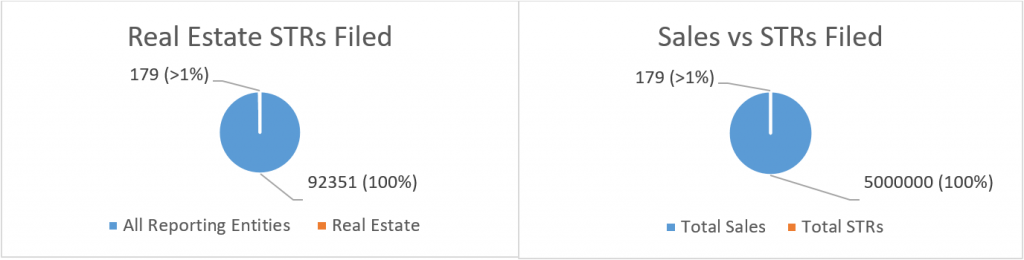
To put things into perspective, though the actual size of the real estate market is difficult to determine precisely, CMHC has produced some statistics.  CMHC suggests that between 2003 and 2013 over $9 trillion of mortgage credits were negotiated and roughly 5 million sales took place through Multiple Listing Services (MLS).  In contrast, FINTRAC received only 127 Suspicious Transactions Reports (STRs) from real estate brokers, agents and developers and 152 by other types of reporting entities, such as banks and trust/loan companies.  To go a step further, in FINTRAC’s 2015 Annual Report, between April 1, 2014 and March 31, 2015, a total of 92,531 STRs were filed across all reporting entities.


re-strs-filed-vs-sales

This evidence supports FINTRAC’s assertion that operational guidance for the real estate industry is needed.

The indicators and examples covered in the brief outline numerous scenarios that may suggest that a transaction is related to a money laundering or terrorist financing offense.  It also speaks to how the appearance of legitimacy obfuscates the clarity of suspicious transactions and requires more than a just “gut feel”.  What is required is the consideration of the facts related to the transaction and their context.  Does the transaction with all the known factors, positive or negative, make sense?


What This Means to Your Business? 

First off, FINTRAC will be using the indicators provided to assess your compliance with reporting obligations.  This has a couple different applications.  The first being, does your AML compliance program documentation make reference to the suspicious indicators that are provided.  Basically, are staff aware of the elements that may be present in a transaction that would suggest money laundering or terrorist financing may be occurring?

Secondly, is there an oversight process to ensure if there are transactions that contain one or more of these indicators where an STR was not submitted, is reviewed?  If so, does the process ensure supporting evidence that the Compliance Officer reviewed the transaction and determined there were not reasonable grounds to suspect its relation to money laundering or terrorist financing?  When you encounter a transaction involving any of the indicators provided, it is very important that you collect as much information as possible to assist the Compliance Officer with their determination of whether there are reasonable grounds to suspect that a transaction, or attempted transaction, may be related to money laundering or terrorist financing.  Alternatively, even if none of the indicators provided by FINTRAC are present but we still feel there is “something off” about our customer’s transaction, speak with your Compliance Officer.  They will be able to provide some insight on additional information that may assist our decision.  Once you have collected any additional information you may still not feel comfortable, but this does not mean you cannot complete the transaction, but that you must be sure your Compliance Officer is provided with all the information, which includes our reason for the escalation, so that they can decide whether there are reasonable grounds to suspect it may be related to a money laundering or terrorist financing offense.  The Compliance Officer will document their decision and, if necessary, submit an STR to FINTRAC.

Need a Hand?

If you are a reporting entity that interacts with the real estate industry and would like assistance updating your AML compliance program documentation or simply have some questions, please contact us.

Sanctions This Week: July 25th – 29th, 2016


OSFISanctions Pic

There were no updates released from OSFI this week.

Go to the OSFI lists page.

OFAC

The U.S. Department of Treasury’s Branch, The Office of Foreign Asset Control (OFAC), released four updates last week.  One update was related to the publication of Cuba-related Frequently Asked Questions (FAQ), covering some of the recent changes made to the sanctions that had previously been placed on Cuba.  Other updates included the removal of 12 individuals from the Counter Terrorism Designations List, the issuance of a Finding of Violation and the publication of Iran General License J.

OFAC administers and enforces economic and trade sanctions based on U.S. foreign policy and national security goals.  The sanctions target countries, regimes, terrorists, international narcotics traffickers, the proliferation of weapons of mass destruction, and other threats to the national security, foreign policy or economy of the U.S.

The update to the Cuba-related FAQs was for the issuance of a new FAQ (#38) and a revision of an existing FAQ (#39), relating to certain information collection and recordkeeping requirements for persons subject to U.S. jurisdiction who provide authorized carrier or travel services to or from Cuba for specifically licensed travelers.

The update to the Counter Terrorism Designations List included the removal of 12 individuals of Libyan origin who are currently residing in the UK.

The Finding of Violation was issued to Compass Bank, which uses the trade name BBVA Compass, for violations of the Foreign Narcotics Kingpin Sanctions Regulations. From June 12, 2013 to June 3, 2014, Compass maintained accounts on behalf of two individuals on OFAC’s List of Specially Designated Nationals and Blocked Persons (the “SDN List”).

The final update of the week was related to OFAC issuing “General License J”, authorizing the re-exportation of certain civil aircraft to Iran on temporary sojourn and related transactions.

See the Cuba-related FAQ update on OFAC’s website.

See the Counter Terrorism Designations List update on OFAC’s website.

See the issuance of a Finding of Violation to Compass Bank on OFAC’s website.

See the Iran General License J details on OFAC’s website.

See OFAC’s recent actions page.

Need A Hand?

We would love to hear from you.  If there are subjects in this post that you would like to know more about, or if you need assistance with your compliance program, please contact us.

Sanctions This Week: July 18th – 22nd, 2016

OSFIOutlier3_032

On July 18th and 22nd, 2016, the Office of the Superintendent of Financial Institutions (OSFI) released the United Nations Security Council’s (UNSC’s) Al’Qaida and Taliban regulations updates to the sanctions list, deleting one individual and amending another.

The individuals are subject to the assets freeze, travel ban and arms embargo set out in paragraph 2 of Security Council resolution 2253 (2015) adopted under Chapter VII of the Charter of the United Nations.

The review of the individual who was deleted from the list was triggered by regularly scheduled updates.  However, no additional information was available regarding the justification.

The amendment of one individual’s information included the following:

  • A physical description;
  • The confirmation of the most recent position held within the Taliban, as of April 2015; and
  • That they are currently involved in drug trafficking and operate a heroin laboratory in Afghanistan.

See the July 18th update on the United Nations (UN) website.

See the July 22nd update on the United Nations (UN) website.

Go to the OSFI lists page.

OFAC

The U.S. Department of Treasury’s Branch, The Office of Foreign Asset Control (OFAC), released three updates last week.  One update was related to the addition of three individuals to the Counter Terrorism Designations list.  The second update was related to the addition of multiple individuals and entities to the Syria and Non-proliferation Designations lists.  The final update last week was to the Kingpin Act and Panama-related Frequently Asked Questions (FAQs) regarding General Licenses.

OFAC administers and enforces economic and trade sanctions based on U.S. foreign policy and national security goals.  The sanctions target countries, regimes, terrorists, international narcotics traffickers, the proliferation of weapons of mass destruction, and other threats to the national security, foreign policy or economy of the U.S.

The changes to the Counter Terrorism Designations list included three individuals of different nationalities, Saudi Arabia, Egypt and Algeria, though all have been linked to Al Qa’ida.

The update to the Syria Sanctions list included eight individuals, all of whom are Syrian.  The seven entities, which range from construction, to finance to manufacturing industries and vary in location, which include:

  • Syria;
  • Saint Kitts and Nevis;
  • Cyprus;
  • UAE; and

The update to the Kingpin Act and Panama-related FAQs are specific General License 5B and 6B

See the Counter Terrorism Designations list update on OFAC’s website.

See the Syrian and Non-proliferation Designations lists update on OFAC’s website.

See the Kingpin Act and Panama-related General License FAQs update on OFAC’s website.

See OFAC’s recent actions page.

Need A Hand?

We would love to hear from you.  If there are subjects in this post that you would like to know more about, or if you need assistance with your compliance program, please contact us.

Sanctions This Week: July 11th – 15th, 2016

OSFIOutlier3_036

There were no updates released from OSFI this week.

Go to the OSFI lists page.

OFAC

The U.S. Department of Treasury’s Branch, The Office of Foreign Asset Control (OFAC), released one update last week.  The update was related to the addition of two Russian individuals who were added to the Counter Terrorism Designations list.

OFAC administers and enforces economic and trade sanctions based on U.S. foreign policy and national security goals.  The sanctions target countries, regimes, terrorists, international narcotics traffickers, the proliferation of weapons of mass destruction, and other threats to the national security, foreign policy or economy of the U.S.

No other information was available on the individuals who were added.

See the Counter Terrorism Designations list update on OFAC’s website.

See OFAC’s Recent Actions page.

Need A Hand?

We would love to hear from you.  If there are subjects in this post that you would like to know more about, or if you need assistance with your compliance program, please contact us.

Return to Blog Listing