


PROCESSING...

Anti-Money Laundering
Consulting Services & Strategies

0 Items - Total: $0.00 CAD

The Proposed Retail Payment Activities Regulations

Background

On February 11, 2023, the proposed Retail Payment Activities Regulations were published in the Canada Gazette. This is to support the Retail Payment Activities Act (RPAA) which was released under Bill C-30 and received royal assent in June 2021. The Retail Payment Activities Regulations are required to bring the RPAA into force.

A Payment Service Provider (PSP) is defined as an individual or entity who performs payment functions as a service or business activity that is not incidental to another service or business activity. Certain entities, such as financial institutions, are exempt as they are regulated under other federal obligations (i.e., Office of the Superintendent of Financial Institutions’ Operational Risk and Enterprise Risk management guidelines.)

The current lack of requirements and supervision increases risks, such as the risk of financial loss in instances of business insolvency, and threats to the security of sensitive personal information. The Regulations aim to address gaps in the supervision of unregulated PSPs and are meant to align with other jurisdictions which already have regimes for PSPs.

The principles that guide the Regulations are:

  • Necessity — supervision should address risks that lead to significant harm to end users and avoid duplication of existing rules;
  • Proportionality — level of supervision should be commensurate with the level of risk posed by the payment activity;
  • Consistency — similar risks should be subject to a similar level of supervision; and
  • Effectiveness — requirements should be clear, accessible and easy to integrate within different payment services.

PSPs will be required to apply and register with The Bank of Canada (no date for this yet). There is a proposed registration fee of CAD 2500. Additionally, an annual assessment fee will be required.

In the following sections, we have summarized what we feel are the most important requirements to note.

Operational Risk Management

PSPs will have to implement and maintain an Operational Risk Framework consisting of the following:

  • Identify its operational risks (i.e., business continuity, cybersecurity, fraud, data management, information technology, human resources, process and product design and implementation, change management, physical security and third parties);
  • Protect its retail payment activities from those risks;
  • Detect incidents and control breakdowns;
  • Respond to and recover from incidents;
  • Review, test and audit its Risk Management Framework;
  • Establish roles and responsibilities for the management of operational risk;
  • Have access to sufficient human and financial resources; and
  • Manage risks from third-party service providers, agents and mandataries.

PSP must ensure that the above are proportional to the impact that a reduction, deterioration, or breakdown of its payment activities could have on end users.

Incident Response

Under the proposed Regulations, PSPs must develop a comprehensive plan for investigating, responding to and recovering from incidents that have a material impact on an end user. An incident is defined as an event or series of related events that is unplanned and that results in or could reasonably be expected to result in the reduction, deterioration or breakdown of any payment activity performed by a PSP.

The incident would be reported to the Bank of Canada and would include the following at a minimum:

  • A description of the incident;
  • The impact on individuals or entities listed in the Act; and
  • Actions taken by the PSP to respond to the incident.

There would also need to be a notice to impacted end users and other impacted parties.

PSPs can only resume operations after an incident once they have verified the integrity and confidentiality of all systems, data and information have been restored, and that it is able to perform retail payment activities without reduction, deterioration or breakdown.

Audit, Testing and Training

Under the proposed Regulations, PSP’s will have to complete various types of testing related to the Framework and have training in place.

All staff who have a role in establishing, implementing or maintaining the PSP’s Risk Management Framework must be provided with the information and training that are necessary to carry out that role.

Framework Review

On at least an annual basis, PSP’s must evaluate its compliance with regulatory requirements. Such a review is also required before any significant changes are made to the PSP’s operations or controls after an incident (defined in the section above).  The findings of the review must be reported to a senior officer.

Testing

PSPs must also establish and implement a testing methodology to determine the effectiveness of its Risk Management Framework. This must be tested at least once every three years and findings must also be provided to a senior officer.

Independent Review

In addition to the above, a PSP must have their Framework independently reviewed at least every three years. The review must be documented and describe the scope, methodology use and findings. Findings of the review must be reported to a senior officer.

Biennial Independent Review

PSPs must have requirements related to safeguarding of funds tested at least once every two years by a sufficiently skilled individual who has had no role in the establishment, implementation, or maintenance of the safeguarding requirements under a PSPs Framework. We discuss what safeguards requirements are below.

Safeguards

PSPs will be required to hold customer funds in a trust account or a segregated account, with insurance or a guarantee to safeguard end-user funds against financial losses due to insolvency.

For consumer protection, the Regulations contain requirements to protect the end user from loss. These requirements include:

  • End-user funds must be held at prudentially regulated financial institutions;
  • Insurance or guarantee cannot be from an affiliate of the PSP;
  • The proceeds from the insurance or guarantee cannot form part of the PSP’s estate;
  • The Bank of Canada must be notified at least 30 days in advance of the cancellation of the insurance or guarantee;
  • PSPs must implement and maintain a written fund safeguarding framework to ensure that end-users have reliable access to their funds without delay; and
  • PSPs must keep a ledger with the names of their end-users and the amount of funds held.

This will require detailed flow of funds documentation.

Reporting

Under the proposed Regulations , PSPs will have to complete various types of reports.

Annual Report

PSPs will need to provide an annual report to the Bank of Canada, no later than March 31 of each year.  Some of the information that must be contained in the report is:

  • A description of any changes made to the payment service provider’s risk management and incident response framework;
  • A description of the human and financial resources for implementing and maintaining the risk management and incident response framework;
  • A description of the PSP’s operational risks in respect of the reporting year, their potential causes and the manner in which they were identified;
  • A description of the systems, policies, procedures, processes, controls, including any approvals required;
  • A description of training;
  • A description of all reviews, and independent reviews; and
  • A description of any incidents that the payment service provider experienced during the reporting year.

Also, the report will need to contain certain volume and value statistics related to the services a PSP is providing.

Significant Change Report

PSPs will be required to notify the Bank of Canada, at least five days in advance, before making a significant change that could materially impact operational risks or the safeguarding of end user funds.

The information that must be contained in the report is:

  • The name and contact information of the individual who may be contacted regarding the significant change;
  • A description of the change or new activity to be performed;
  • The reason for the change or new activity;
  • The date on which the change is to be made;
  • The PSP’s assessment of the effect that the change or new activity will have on its operational risks; and
  • A copy of all documentation in relation to the PSP’s Risk Management Framework, that has been amended to reflect the change or new activity, including any necessary approvals.

If a PSP has senior officers, the change or new activity must be approved and receive formal sign off by senior management before submission of a report. This should be taken into account from a planning perspective, as it can take some time to obtain such internal approvals.

Incident Report

PSPs must report incidents that have a material impact on an end user, other PSPs, or designated financial market infrastructures, to the Bank of Canada and other impacted individuals and entities.

The information that must be contained in the report is:

  • A description of the incident;
  • What impact does the incident have on individuals and entities; and
  • What actions have been taken by the PSP to respond and remediate.

The Regulations do not make it clear what timeframe is required for reporting such incidents, however they do state the standard time to respond to a request from the Bank of Canada is 15 days. Failure to report an incident can result in an administrative monetary penalty classified as very serious.

What Does This Mean?

From the highlights, it’s evident that these Regulations will create a substantial burden for PSPs, especially ones that are smaller or just starting. A significant amount of time, resources and cost are going to be needed to manage the compliance requirements that PSPs will need to follow. If a PSP does not comply or there is partial compliance, they may be subject to administrative monetary penalties that range from CAD 1,000,000 per each serious violation, up to CAD 10,000,000 per each very serious violation. The draft Regulations did not make clear what a dispute process would like.

It should be noted that most PSPs captured under the RPAA are also considered money services businesses (MSBs), and as such must also comply with anti-money laundering (AML) compliance obligations. Check out our blog related to that here.

What Next?

Due to these changes not being final, we wait. There is no set date for when we can expect final legislation or when they will come into force, but it is a good time to start budgeting and align resources.

Also, as there is a 45-day comment period for the proposed Regulations which closes on March 28, 2023, PSPs should review the Regulations carefully and provide feedback. Comments can be submitted online via the commenting feature after each section of the proposed Regulations, via email, or via regular mail to Nicolas Marion, Senior Director, Payments Policy, Department of Finance, 90 Elgin Street, Ottawa, Ontario K1A 0G5.

We’re Here To Help

If you have questions related to the proposed changes, or need help starting to plan, you can get in touch using the online form on our website, by emailing us at info@outliercompliance.com, or by calling us toll-free at 1-844-919-1623.

First AML Compliance Effectiveness Review Timing

As a company that gets to work with a lot of startups, and existing companies entering the Canadian market, we get to help folks understand the regulatory landscape in Canada. One of the required elements of a Canadian compliance program is an AML Compliance Effectiveness Review. These reviews must be completed every two years at a minimum. You can think of it like an audit, but for compliance.

The purpose of an effectiveness review is to determine whether your AML compliance program has gaps or weaknesses that may prevent your business from effectively preventing, detecting and deterring money laundering and terrorist financing. Recently, we have seen an increased focus on Effectiveness Reviews during FINTRAC examinations. Specifically, on whether the review really tested the effectiveness of the compliance program as a whole (not just what you say you’re doing, but also what you’re actually doing). This has led to FINTRAC examiners requesting the working papers for completed effectiveness reviews where the report did not clearly describe how the effectiveness was tested and assessed. This is the main reason Outlier has started providing our working papers with the final report. This also provides a pretty good reference point for making sure you are meeting your regulatory expectations.

First Time for Everything

In previous engagements, Outlier has operated on the theory that the clock for when your first review was due stemmed from the MSB’s FINTRAC registration date. However, we were incorrect. It wasn’t until a recent conversation where the registration date preceded any customer transactions by six months, that really spurred on an official clarification from the regulator. The trigger for the 2-year clock to start ticking is not registration but “a registered MSB is required to create a compliance program once it engages in one or more of the MSB-related activities.” This means that the clock starts ticking after the MSB has conducted their first transaction.

Here is a PDF version of the policy interpretation we received from FINTRAC that you can keep for your records.

Potential Corrections

If we have completed a review for you in the past that has a commencement date prior to your first customer transaction, please feel free to reach out so we can amend your report to the proper date.

Upcoming Effectiveness Reviews

While this article talks about your first review, you must also be sure to initiate all subsequent reviews within 2 years of the start date of your previous review. Please note that this is based on the previous commencement date, not the date of completion or issuance of the final report.

Need a Hand?

If you are looking for an idea of pricing for an upcoming review or have questions about a review that is currently underway, please feel free to contact us.

EFTs, PSPs & Crowdfunding : Canada’s Changing Regulatory Landscape

On April 27th, 2022 amendments to the Proceeds of Crime (Money Laundering) and Terrorist Financing Regulations (PCMLTFR) and associated regulations related to penalties for non-compliance were passed. These amendments were unusual, as there was little prior public consultation, no pre-publication for public comment, and they came into force “on publication” (right away). This is particularly unusual, as new business models were included in the money services business (MSB) and foreign money services business (FMSB) categories.

Specifically, a number of payment services providers (PSPs) became MSBs through a change in the definition of electronic funds transfers (EFTs), and companies that provide crowdfunding services also became MSBs/FMSBs. Historically, these types of changes would have included a pre-publication of the proposed amendment with time for industry participants to comment. There is also, generally, a period of time between the publication of final amendments and the coming into force date (often a year). Absent these buffers, both industry and Canada’s AML regulator, the Financial Transactions and Reports Analysis Centre of Canada (FINTRAC) have been scrambling to assess the many nuances of the amendments.

While we’ve seen a number of responses to individual applicants for MSB registrations and requests for policy interpretations from FINTRAC, today’s release was the first substantial piece of public guidance from the regulator. For those inclined, it can be accessed here: https://fintrac-canafe.canada.ca/notices-avis/2022-07-21-eng

EFTs and PSPs

What may have seemed like an inconsequential change to the definition of EFTs, which removed certain exemptions, has significant impacts on payment services providers.

“As payment services are not a prescribed service under the PCMLTFA, FINTRAC is taking the position that persons or entities that provide invoice payment services or payment services for goods and services are engaged in the business of remitting or transmitting funds, or dealing in virtual currency.”

FINTRAC’s guidance goes on to define each of these activities and the (very limited) exemptions in each case.

Crowdfunding

While crowdfunding gets a nod in the title of the guidance, it doesn’t really factor into the substance of today’s piece. There are definitions in the amendments themselves in this case, and it’s likely that additional guidance will follow as FINTRAC works through these registrations.

“crowdfunding platform means a website or an application or other software that is used to raise funds or virtual currency through donations. (plateforme de sociofinancement)”

“crowdfunding platform services means the provision and maintenance of a crowdfunding platform for use by other persons or entities to raise funds or virtual currency for themselves or for persons or entities specified by them. (services de plateforme de sociofinancement)”

FINTRAC’s MSB/FMSB Registration Process

The guidance notes that FINTRAC is working on getting businesses registered “over the next several weeks.” As there are many businesses that will be newly registering as MSBs or FMSBs, industry participants should expect some delays. It has also become much more common for FINTRAC to ask for additional details about the business, such as the business model and flow of funds.

There is also a tool to check to see if your business should be registered: https://www.fintrac-canafe.gc.ca/msb-esm/questions/2-eng

If you’re ready to register, you can find an overview of the process and links to the pre-registration form here: https://fintrac-canafe.canada.ca/msb-esm/register-inscrire/reg-ins-eng

Requesting Policy Interpretations

There are two important FINTRAC email addresses. If you have a question specifically about whether or not your business should register, first try msb-esm@fintrac-canafe.gc.ca.

For other policy interpretation requests (or if your request is particularly complex), your best avenue is most likely guidelines-lignesdirectrices@fintrac-canafe.gc.ca.

Enforcement Actions

FINTRAC’s guidance indicates that the regulator will take a reasonable approach to entities required to register.

“We understand that there will be challenges in meeting certain obligations. FINTRAC will be reasonable in its assessment and enforcement approach, and is committed to working with reporting entities subject to the PCMLTFA and its Regulations to increase their awareness, understanding and compliance with their obligations. Please continue to monitor our website for updates or additional guidance.”

This gentle approach will not last indefinitely. If your business needs to be registered (and get its house in order AML compliance-wise), it’s time to get started.

We’re here to help.

Whether you want a hand drafting a policy interpretation request, an AML compliance program, or training for your newly minted AML Compliance Officer (congratulations, I’m sorry), we’re here to help. Please get in touch.

Effectiveness Reviews for Dealers in Virtual Currency

Effective June 1, 2020, dealers in Virtual Currency activities were considered as Money Services Businesses (MSBs) and as such, must comply with MSB obligations under amendments made to the Proceeds of Crime (Money Laundering) and Terrorist Financing Act (PCMLTFA). One obligation is to have an AML effectiveness review at least once every two years. MSBs must start their effectiveness review no later than two years from the start of their previous review or in the case of dealers in Virtual Currency, no later than June 1, 2022, the date they were considered to be MSBs under law.

Such reviews must test your compliance program and effectiveness of your operations. Our reviews follow a similar format to examinations conducted by the Financial Transactions and Reports Analysis Centre of Canada (FINTRAC), which you can read more about in a previous Blog Post.

We’re Here To Help

If you have not yet engaged or commenced your review, there are still a couple of weeks to be compliant. If you would like to engage Outlier to conduct your AML Compliance Effectiveness Review or have questions regarding this obligation, please get in touch.

Amendments To The Proceeds of Crime (Money Laundering) and Terrorist Financing Regulations – 2022

Background

On April 27, 2022 amendments to the Proceeds of Crime (Money Laundering) and Terrorist Financing Regulations were published in the Canada Gazette. To make reading these changes a little easier, we (thanks Rodney) have created a redlined version of the regulations, with new content showing as tracked changes, which can be found here.

The Regulatory Impact Statement for these changes state the following:

Crowdfunding platforms and some payment service providers are not currently covered by the Proceeds of Crime (Money Laundering) and Terrorist Financing Act (the Act) and therefore have no money laundering and terrorist financing obligations under federal statute. This lack of oversight presents a serious and immediate risk to the security of Canadians and to the Canadian economy. This risk was highlighted in early 2022, when illegal blockades took place across Canada that were financed, in part, through crowdfunding platforms and payment service providers. Allowing these gaps to continue represents a risk to the integrity and stability of the financial sector and the broader economy, as well as a reputational risk for Canada.

Amendments to the Proceeds of Crime (Money Laundering) and Terrorist Financing Regulations, and consequential amendments to the Proceeds of Crime (Money Laundering) and Terrorist Financing Administrative Monetary Penalties Regulations, will help prevent the financing of illegal activities through these types of financial services.

What’s Changed?

The changes are substantial and sudden. They will affect many companies that have not been previously under the purview of AML regulation in Canada. These changes are effective immediately and there is no comment period, which is not the norm for such changes.

To help digest these changes, we have summarized what we feel are the most important changes below:

The definition for an electronic funds transfer has been removed and the corresponding section within the body of the regulations was amended. Previous exemptions related to remitting or transmitting from one person or entity to another by Credit or Debit Card, or Prepaid Payment Product if the beneficiary has an agreement with the payment service provider that permits payment for the provision of goods and services, has been revoked for money services businesses, which as we mentioned now includes Payment Service Providers.

The definitions section was amended by adding the following:

  • crowdfunding platform means a website or an application or other software that is used to raise funds or virtual currency through donations. (plateforme de sociofinancement)
  • crowdfunding platform services means the provision and maintenance of a crowdfunding platform for use by other persons or entities to raise funds or virtual currency for themselves or for persons or entities specified by them.

With these changes, crowdfunding platforms and payment service providers will now be subject to existing money services businesses requirements. These obligations include:

  • Registration with FINTRAC;
  • Developing a compliance program;
  • Customer identification and due diligence;
  • Transaction monitoring and customer risk scoring;
  • Reporting certain transactions to regulators and government agencies;
  • Complying with Ministerial Directives; and
  • Keeping records.

Specific to record keeping, crowdfunding platforms that provide services to persons or entities in Canada where a person donates an amount of CAD 1,000 or more in funds or virtual currency will need to:

(a) keep an information record in respect of the person or entity to which they provide those services;

(b) keep a record of the purpose for which the funds or virtual currency are being raised; and

(c) if the person or entity for which the funds or virtual currency are being raised is different from the person or entity referred to in paragraph (a),

      1. keep a record of their name, and
      2. take reasonable measures to obtain their address, the nature of their principal business or their occupation and, in the case of a person, their date of birth, and keep a record of the information obtained.

What Next?

Due to these changes, FINTRAC will need to revise its interpretation of existing requirements to include crowdfunding platforms and payment service providers. There is no set date for when we can expect guidance from FINTRAC. Additionally, various FINTRAC policy interpretations will no longer be able to be relied upon (i.e. policy interpretations related to merchant services as well as payment processing for utility bills, mortgage and rent, payroll, and tuition being exempt from AML obligations). The hope is FINTRAC will issue new policy interpretations, but for now the industry is left with many questions.

We’re Here To Help

If you would like assistance in understanding what these changes mean to your business, or if you need help in creating or updating your compliance program and processes, please get in touch.

Are You a Foreign Money Services Business?

Background

On July 10, 2019 amendments to the Proceeds of Crime (Money Laundering) and Terrorist Financing Act (PCMLTFA) and its enacted regulations were released in the Canada Gazette. The amendments require entities that conduct MSB activities from outside of Canada, directed towards Canadians, to be considered Foreign Money Services Businesses (FMSBs) and therefore comply with Canadian AML obligations.  Foreign MSBs must register with the Financial Transactions and Reports Analysis Centre of Canada (FINTRAC) and become compliant by June 1, 2020. Check out our blog post to see what your full requirements are.

What Is A Money Services Business?

You are considered an MSB in Canada if your business offers any of the following services:

  • Foreign exchange dealing;
  • Remitting or transmitting funds;
  • Issuing or redeeming money orders, traveller’s cheques and other negotiable instruments; or
  • Dealing in virtual currencies.

What Is A Foreign Money Services Business?

You are considered an FMSB if all of the following criteria applies to your business:

  • The person or entity is engaged in the business of providing at least one money services business (MSB) service;
  • The person or entity does not have a place of business in Canada;
  • The person or entity directs its MSB services at persons or entities in Canada; and
  • They provide these services to clients in Canada. 

For further clarity, you must direct services at persons or entities located in Canada. FINTRAC clarifies that directing services means that the services offered takes into consideration a Canadian audience. For example, if marketing or advertising materials are used with the intent to promote services and to acquire business from persons or entities in Canada. Where a business advertises online, but may not specifically exclude Canadian IP addresses, this fact on its own would not constitute directing services at persons or entities in Canada.

A business would be seen as directing services at persons or entities in Canada if at least one of the following applies:

  • The business’s marketing or advertising is directed at persons or entities located in Canada; 
  • The business operates a “.ca” domain name; or
  • The business is listed in a Canadian business directory.

Note that additional criteria may be considered when determining whether you are directing services at persons or entities in Canada. Examples of the additional criteria that may be considered is outlined in FINTRAC’s FMSB Annex 1.

We’re Here To Help

If you are, or think you may be, a foreign MSB and have any questions related to your compliance obligations in Canada, please get in touch!

Amending the Amendments!

Background

Back on July 10, 2019, the highly anticipated final version of the amendments to the Proceeds of Crime (Money Laundering) and Terrorist Financing Act (PCMLTFA) and its enacted regulations were published. However, on February 15, 2020, further proposed amendments to those amended regulations was published in the Canada Gazette. To make reading these changes a little easier, we have created a redlined version of the regulations, with new content showing as tracked changes, which can be found here.

The Regulatory Impact Statement for this round of proposed changes states the following: “The proposed amendments to the regulations would strengthen Canada’s AML/ATF Regime, align measures with international standards and level the playing field across reporting entities by applying stronger customer due diligence requirements and beneficial ownership requirements to designated non-financial businesses and professions (DNFBPs); modifying the definition of business relationship for the real estate sector; aligning customer due diligence measures for casinos with international standards; aligning virtual currency record-keeping obligations with international standards; clarifying the cross-border currency reporting program; clarifying a number of existing requirements; and making minor technical amendments”. The proposed amendments are expected to come into force on June 1, 2021.

As with all proposed changes, there is a comment period. This comment period is much shorter than the last one, at only 30 days. For anyone interested in commenting on the proposed changes, comments are to be addressed to Lynn Hemmings, Director General, Financial Crimes and Security Division, Financial Sector Policy Branch, Department of Finance, 90 Elgin Street, Ottawa, Ontario K1A 0G5 or email: fin.fc-cf.fin@canada.ca.

While these are proposed changes, guidance from FINTRAC related to the amendments to regulation would hopefully be seen ahead of the coming into force dates of the final version.

We have summarized what this could mean for your business below.

Money Services Businesses

PEP

The most significant proposed change for Money Services Businesses (MSB)s is related to Politically exposed persons (PEP) determinations. Currently, a PEP determination must be made for international EFTs of CAD 100,000 or more. The proposed regulations will require MSBs to make a PEP determination when the MSB enters into a business relationship with a person.

If you currently conduct list screening, PEP screening could easily be added to that process.

Dealers in Virtual Currency

Travel Rule

For dealers in virtual currency, there is an additional proposed requirement on top of the requirements that were published in the last round of AML changes.  The proposed amendments add the requirement for records to be kept for virtual currency transfers of CAD 1,000 or more.

The record must contain the following:

  1. include with the transfer, the name, address and, if any, the account number or other reference number of both the person or entity that requested the transfer and the beneficiary; and
  2. take reasonable measures to ensure that any transfer received includes the information referred to in paragraph (a) above.

If the information required is not obtained, a determination of whether the transaction should be suspended or rejected will need to be made.

Given the nature of virtual currency transfers, it will be interesting to see how this requirement plays out, as currently, there are no technology solutions (that we are aware of) that would solve for this.

A reminder that dealers in virtual currency will be considered MSBs as of June 1, 2020. Check out our blog post for a full list of regulatory requirements related to dealers in virtual currency.

Real Estate

Business Relationship

One of the most significant proposed changes for real estate developers, brokers and sale representatives is related to the definition of a business relationship. Currently, a business relationship is defined as:

If a person or entity does not have an account with you, a business relationship is formed once you have conducted two transactions or activities for which you have to:

  • verify the identity of the individual; or
  • confirm the existence of the entity.

The proposed amendments will change that definition for real estate developers, brokers and sale representatives to only one transaction.

For business relationships, a reporting entity must:

  • keep a record of the purpose and intended nature of the business relationship;
  • conduct ongoing monitoring of your business relationship with your client to:
    • detect any transactions that need to be reported as suspicious;
    • keep client identification and beneficial ownership information, as well as the purpose and intended nature records, up-to-date;
    • reassess your clients risk level based on their transactions and activities; and
    • determine if the transactions and activities are consistent with what you know about your client;
  • keep a record of the measures you take to monitor your business relationships and the information you obtain as a result.

We will have to wait for guidance to see how ongoing monitoring obligations applies to the real estate sector if this change takes effect.

PEP

The proposed amendments will require real estate developers, brokers and sale representatives to make a Politically exposed persons (PEP) determination when they enter into a business relationship (as defined above) with a client. In addition, they will also be required to take reasonable measures to determine whether a client from whom they receive an amount of CAD 100,000 or more is a PEP.

Beneficial Ownership

The proposed amendments will require real estate developers, brokers and sale representatives to comply with existing beneficial ownership requirements that apply to other reporting entities.

This means when identifying an entity, a reporting entity needs to collect the following for all Directors and individuals who own or control, directly or indirectly, 25% or more of the organization:

  • Their full legal name;
  • Their full home address; and
  • Their role and/or ownership stake in the organization.

Given the obligation is to obtain, rather than verify, such information, we do not expect this requirement to be overly burdensome for the real estate sector.

Dealers in Precious Metals and Stones

PEP

Dealers in Precious Metals and Stones (DPMS)s will be required to make a PEP determination when they enter into a business relationship with a client. In addition, a DPMS will be required to take reasonable measures to determine whether a person from whom they receive an amount of CAD 100,000 or more is a PEP.

A reminder that a business relationship is defined as:

If a person or entity does not have an account with you, a business relationship is formed once you have conducted two transactions or activities for which you have to:

  • verify the identity of the individual; or
  • confirm the existence of the entity.

Given the definition of a business relationship, we do not expect this requirement to be overly burdensome. If you currently conduct list screening, PEP screening could easily be added to that process.

Beneficial Ownership

The proposed amendments will required DPMSs to comply with existing beneficial ownership requirements that apply to other reporting entities.

This means when identifying an entity, a reporting entity needs to collect the following for all Directors and individuals who own or control, directly or indirectly, 25% or more of the organization:

  • Their full legal name;
  • Their full home address; and
  • Their role and/or ownership stake in the organization.

Given the obligation is to obtain, rather than verify, such information, we do not expect this requirement to be overly burdensome for the DPMS sector.

We’re Here To Help

If you would like assistance in updating your compliance program and processes, or have any questions related to the changes, please get in touch!

Regulations Amending the Regulations February 15, 2020- Redlined Versions

The following red-lined versions have been created to reflect the amendments to Canadian anti-money laundering (AML) regulations published in the Canada Gazette on February 15, 2020. You can also read our article “Amending the Amendments!” for a summary of the proposed changes by industry.

Redlined versions of all the Proceeds of Crime (Money Laundering) and Terrorist Financing Regulations are listed below for download.

These documents are not official versions of the regulations. Official versions can be found on the Government of Canada’s Justice Laws Website.

Regulations Amending the Regulations Amending Certain Regulations Made Under the Proceeds of Crime (Money Laundering) and Terrorist Financing Act

Please click the link below for downloadable PDF file.
Amending_the_Regulations_Amending_Certain_Regulations_Made_Under_the_Proceeds_of_Crime_July_2019 – Redlined_Feb_2020

Proceeds of Crime (Money Laundering) and Terrorist Financing Regulations

Please click the links below for downloadable pdf files.
PCMLTF_July_2019_Redlined_Full_July_2019 – Redlined_Feb_2020

Proceeds of Crime (Money Laundering) and Terrorist Financing Suspicious Transaction Reporting Regulations

Please click the links below for downloadable pdf files.
PCMLTF_Suspicious_Transaction_Reporting_Regulations_July_2019 – Redlined_Feb_2020

Proceeds of Crime (Money Laundering) and Terrorist Financing Registration Regulations

Please click the link below for a downloadable PDF file.
PCMLTF_Registration_Regulations_July_2019 – Redlined_Feb_2020

Proceeds of Crime (Money Laundering) and Terrorist Financing Administrative Monetary Penalties Regulations

Please click the link below for a downloadable pdf file.
PCMLTF_Administrative_Monetary_Penalties_Regulations_July_2019 – Redlined_Feb_2020

Proceeds of Crime (Money Laundering) and Terrorist Financing Cross-Border Currency and Monetary Instruments Reporting Regulations

Please click the link below for a downloadable pdf file.
PCMLTF_Cross-Border_Currency_and_Monetary_Instruments_Reporting_Regulations_July_2019 – Redlined_Feb_2020

Need a Hand?

Whether you need to figure out if you’re a dealer in virtual currency, to put a compliance program in place, or to evaluate your existing compliance program, we can help. You can get in touch using our online form, by emailing info@outliercompliance.com, or by calling us toll-free at 1-844-919-1623.

Dealers In Virtual Currencies Can Pre-Register With FINTRAC

Last week, the Canadian Federal anti–money laundering agency, the Financial Transactions and Reports Analysis Centre of Canada (FINTRAC), announced that money services businesses (MSBs) dealing in virtual currencies will be allowed to voluntarily register in advance of becoming reporting entities. All dealers in virtual currency (also referred to as cryptocurrency) are expected to register with FINTRAC by June 1, 2020.

The process of registration is relatively straightforward, beginning with a pre-registration form. In order to complete pre-registration, you simply need to provide full business and contact information. There is no cost to register an MSB with FINTRAC, although we’ve heard of several scams claiming that there is a fee. We also suggest that before you hire someone to assist, you try to complete the form on your own. 

To read more on the full registration details and all obligations that will apply to dealers in virtual currency beginning June 1, 2020, check out our blog 2019 AML Regulation Highlights for Dealers in Virtual Currency.

We’re Here To Help

Whether you need to figure out if you’re a dealer in virtual currency, put a compliance program in place, or evaluate your existing compliance program, we can help. You can get in touch using our online form, by emailing info@outliercompliance.com, or by calling us toll-free at 1-844-919-1623.
2019 AML Regulation Highlights for Dealers in Virtual Currency

Back in June 2018, we published an article on proposed AML rules for dealers in Virtual Currency. On July 10th, 2019, updates to Canada’s anti-money laundering (AML) regulations were published in the Canada Gazette. There are three different “coming into force” dates (the dates on which the content of various updates become requirements for regulated entities). 

  • July 10, 2019: a small change in wording (from “original” to “authentic”) is good news for digital identification.
  • June 1, 2020: dealers in virtual currency must be registered as money services businesses (MSBs) and have AML compliance programs in place.
  • June 1, 2021: additional provisions, including reporting large virtual currency transactions.

This is a significant regulatory package with a lot of changes (the document is over 200 pages long). This article will cover the major points for dealers in virtual currency, but it’s important to remember that there is a lot of nuances and differences between business models. We recommend speaking to your local neighbourhood compliance geek about how to adapt to these changes (if you need a compliance geek, please get in touch).

It is also worth noting that tokens that are considered securities would not be considered virtual currencies. Securities and securities dealers were already regulated. If you’re not sure whether or not a token is a security, we recommend reaching out to a securities lawyer (if you need recommendations, please feel free to contact us). It is possible to be both a securities dealer and a dealer in virtual currencies, but if you are only looking for the changes pertinent to securities dealers, you will find those in another article.

Hefty Disclaimers & Sharing

This article should not be considered advice (legal, tax or otherwise). That said, any of the content shared here may be used and shared freely – you don’t need our permission. While we’d love for content that we’ve written to be attributed to us, we believe that it’s more important to get reliable information into the hands of community members (meaning that if you punk content that we wrote, we may think you’re a jerk but we’re not sending an army of lawyers).

Dealers In Virtual Currency

It’s important to start by understanding what’s being regulated. This is best done by considering some of the definitions that have been added to the regulation.

fiat currency means a currency that is issued by a country and is designated as legal tender in that country. (monnaie fiduciaire)

funds means

(a) cash and other fiat currencies, and securities, negotiable instruments or other financial instruments that indicate a title or right to or interest in them; or

(b) a private key of a cryptographic system that enables a person or entity to have access to a fiat currency other than cash.

For greater certainty, it does not include virtual currency. (fonds)

virtual currency means

(a) a digital representation of value that can be used for payment or investment purposes that is not a fiat currency and that can be readily exchanged for funds or for another virtual currency that can be readily exchanged for funds; or

(b) a private key of a cryptographic system that enables a person or entity to have access to a digital representation of value referred to in paragraph (a). (monnaie virtuelle)

virtual currency exchange transaction means an exchange, at the request of another person or entity, of virtual currency for funds, funds for virtual currency or one virtual currency for another. (opération de change en monnaie virtuelle)

In terms of who will be regulated, businesses (whether or not the business is incorporated) that conduct transactions on behalf of their customers, including:

  • Exchanging digital currencies for fiat currencies; and 
  • Exchanging between virtual currencies.

This would include custodial wallet services that hold customers’ private keys on their behalf, as well as exchanges, brokerages, and automated teller machines (ATMs). The requirements apply to foreign and domestically based businesses. The inclusion of foreign MSBs means that it won’t matter where your business is incorporated. If you are targeting your services to Canadians, you are expected to comply with Canadian rules and you will need to be aware of requirements as they apply to your Canadian customers.

One of the most important notes in our view is “These amendments serve to mitigate the money laundering and terrorist activity financing vulnerabilities of virtual currency in a way that is consistent with the existing legal framework, while not unduly hindering innovation. For this reason, the amendments are targeted at persons or entities engaged in the business of dealing in virtual currencies, and not virtual currencies themselves.” It is expected that there will be additional updates to the regulations, and community consultations. During these processes, this distinction should remain an important one.

Digital Identification and “Authentic” Documents

Canadian businesses, such as MSBs, that are regulated for AML purposes must identify certain customers either because there is an ongoing service agreement, an account, or because the customer performs specific types of transactions. In these instances, the methods used to identify customers are prescribed in the regulations. Previously, there was a requirement that any document that was used in identification processes be “original”. A narrow view was taken of the definition of the word original: the document itself, in whatever form it was issued. No scans, copies or other digital representations were permitted. This was a significant challenge in non-face-to-face environments.

Effective on publication of the updates, the word “original” has been replaced with “authentic”. It’s important to keep in mind that while this does allow for documents to be submitted in a myriad of digital formats, there will be an expectation that reporting entities do something in order to determine whether or not the document is authentic. The regulations are not prescriptive in terms of how this will be done. We expect that a number of different solutions, ranging from having a human review documents, to using AI to make risk-based determinations, will be valid. If there are processes that you aren’t sure about, it is possible to write to FINTRAC to request a policy interpretation. We expect that FINTRAC will release updated guidance on identification, and issue many subsequent policy interpretations as the landscape evolves.

For customers that were previously identified, there is an expectation that the customer is identified in accordance with the rules that were in place at the time. Unfortunately, this means that if a customer was identified before the updated regulations were published, and an electronic version of a document was used, the identification may not be considered complete. It will be important for businesses to assess the processes that were in place at this point in time in order to make an accurate determination of whether or not the standards were being met.

Registering as a Money Services Business (MSB)

Although the legislation has been published, Dealers in Virtual Currency are not yet able to register as money services businesses (MSBs) with FINTRAC, Canada’s federal AML regulator and financial intelligence unit (FIU). The process is relatively straightforward, beginning with a pre-registration form. 

The FINTRAC registration process is generally very efficient (taking two to four weeks in total). As part of this process, you must provide FINTRAC with complete information about your business, including:

  • Bank account information;
  • Information about your compliance officer;
  • Number of employees;
  • Incorporation information (if your business type is a corporation);
  • Information about your MSB’s owners and senior management, such as their name and date of birth;
  • An estimate of the expected total dollar amount of transactions per year for each MSB service you provide;
  • Detailed information about every branch; and
  • Detailed information about every Canadian MSB agent.

You are not required to have locations or offices in Canada in order to register as an MSB with FINTRAC. Once registered, the registration must be maintained and you must:

  • Keep registration information up to date;
  • Respond to requests for, or to clarify information, in the prescribed form and manner, within 30 days;
  • Renew our registration before it expires; and
  •  Let FINTRAC know if we stop offering MSB services to Canadians

SCAM ALERT: There is no cost to register an MSB with FINTRAC – although we’ve heard of several scams claiming that there is a fee. Please ensure that you are only registering through valid FINTRAC sites, which will contain “fintrac-canafe.gc.ca” in the url. If you have received a phishing email or other request to pay FINTRAC registration fees, we recommend reporting this to both the Canadian Anti-Fraud Centre and to FINTRAC directly.

All dealers in virtual currency are expected to register with FINTRAC by June 1, 2020.

Building or Updating Your Compliance Program

MSBs in Canada are required to have a documented AML compliance program in place. In all instances, when something is a requirement it’s not enough to have done something to meet that requirement. Both your process and what you’ve actually done in order to meet the requirement must be documented. An AML compliance program has these elements:

  1. Compliance Officer: this is the person who will be responsible for your AML compliance program. They should understand Canadian AML requirements, be relatively senior in your company (access to your Board and Management team is necessary), and sign up to receive updates from FINTRAC.
  2. Policies and Procedures: these are documents that describe what you are required to do, and how you will do it. The processes should be an accurate description of what you are actually doing and detailed enough that a new hire could follow them.
  3. Risk Assessment: this is a document that considers the risk that your business could be used to launder money and/or finance terrorism. FINTRAC has released detailed guidance for MSBs to help create this type of document.
  4. Ongoing Training: any staff (including part-time and temporary staff) that deal with customers, transactions, and systems must receive training on a regular basis (this is generally interpreted to mean at least annually). It’s fine to rely on an external vendor, but your training should also include training on your processes.
  5. AML Compliance Effectiveness Reviews/Audits: every two years, you must complete a formal review of the effectiveness of your AML compliance program and operations. This can be conducted internally or by an external vendor.

In addition, to your documented program, you will need to ensure you operate in a compliant manner which includes, registering with FINTRAC, identifying customers under certain circumstances (more on this under customer identification), collect know your customer (KYC) information, keep records, and report certain transactions to FINTRAC.

All dealers in virtual currency are expected to have compliance programs in place and operational by June 1, 2020.

Customer Identification and Collecting KYC Information

For dealers in virtual currency, customer identification and the collection of KYC information will be required where virtual currency exchange transactions valued at CAD 1,000 or more are conducted. This will include exchanging fiat for virtual currency, as well as exchanges between virtual currencies.

Customers must also be identified, where possible if there are reasonable grounds to suspect that a transaction is related to money laundering or terrorist financing. When a transaction is suspicious, there is no minimum value threshold for identification.

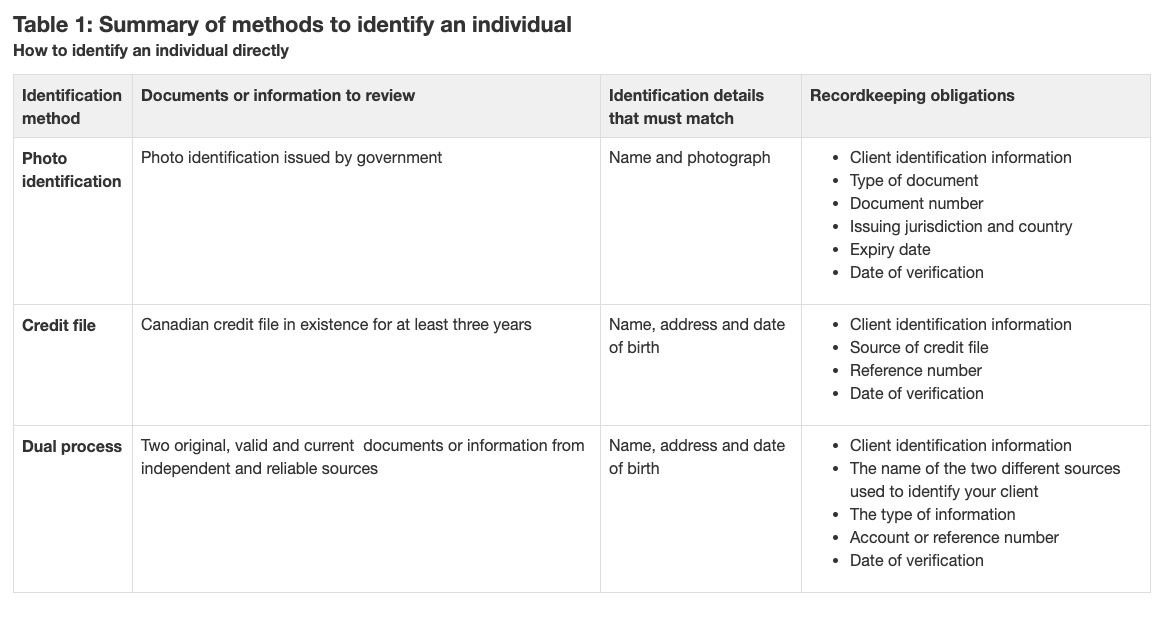
Identification in this context must be completed in specific ways, each of which require particular records to be maintained. The chart below is from FINTRAC’s current customer identification guidance (which must be updated to reflect the change in wording from original to authentic, though other elements remain unchanged).

If the customer is an entity (a company, partnership, trust, etc.), then measures must be taken to confirm the entity’s existence and beneficial ownership. Certain details must be collected for directors, trustees, beneficiaries of trusts, and anyone that owns or controls 25% or more of an entity. This includes “indirect ownership” (such as ownership through another company).

There is also information about the customer that must be collected. For individuals, this includes name, date of birth, address, and occupation or principal business. For entities, this includes name, address, place of incorporation (if applicable), and incorporation number (if applicable). 

All dealers in virtual currency are expected to have processes in place to identify customers and collect KYC information by June 1, 2020.

FINTRAC Reporting

For reporting, there are two important dates. By June 1, 2020, dealers in virtual currency will need to report the same types of transactions that MSBs are currently required to report. These are:

  • Large Cash Transactions: if you receive cash (this means fiat in the form of bills and/or coins) valued at CAD 10,000 or more in the same 24-hour period, by or on behalf of the same customer, it must be reported to FINTRAC within 15 calendar days. 
  • Suspicious Transactions: if there are reasonable grounds to suspect that a transaction is related to money laundering or terrorist financing, it must be reported to FINTRAC within 30 calendar days of the discovery of a fact that led you to determine that the transaction was suspicious.
  • Attempted Suspicious Transactions: if a customer or prospective customer requests a transaction, but does not complete it (including transactions that you reject), and there are reasonable grounds to suspect money laundering or terrorist financing, then it must be reported. The timeframe is the same as it would be for completed transactions.
  • Terrorist Property: if you’re in possession of property (which includes funds and virtual currency) that belong to a terrorist or terrorist group, it must be reported without delay, and the property must be frozen. In addition to reporting to FINTRAC, these reports are also sent to the CSIS and RCMP – by fax. In order to know if customers fall into this category, it is important to screen against lists published by OSFI. We’ve worked with some friends on a tool to make this easier, which you can try here (use the code Free100 for a free trial).
  • Electronic Funds Transfers: if you send or receive international electronic funds transfers (EFTs), including wires, valued at CAD 10,000 or more, by or on behalf of the same customer, it must be reported to FINTRAC within 5 working days.

If you are required to report transactions valued at CAD 10,000 or more in a 24-hour period, you must have a mechanism in place to detect reportable transactions.

It’s noteworthy that if you are conducting international EFTs on your customers’ behalf, you may already be an MSB. The best way to know for certain, in our opinion, is to request a policy position from FINTRAC. This can be done free of charge by emailing guidelines-lignesdirectrices@fintrac-canafe.gc.ca. This can also be done on your behalf by a lawyer or consultant.

By June 1, 2021, a new report will be introduced.

  • Large Virtual Currency Transactions: if you receive virtual currency valued at CAD 10,000 or more in the same 24-hour period, by or on behalf of the same customer, it must be reported to FINTRAC within 5 working days.

There will be some additional changes to reporting and reporting timelines, including the requirement to report suspicious and attempted suspicious transactions “as soon as practicable” after you have determined that there are reasonable grounds to suspect that the transaction is related to money laundering or terrorist financing.

For Extreme Compliance Nerds

We clearly mean nerd as the highest term of admiration and endearment, and for you, we have created red-lined versions of the regulations, with new content showing as tracked changes. This is not an official version of the regulations, and we do, of course, recommend that you check it against the official version.

Need a Hand?

Whether you need to figure out if you’re a dealer in virtual currency, to put a compliance program in place, or to evaluate your existing compliance program, we can help. You can get in touch using our online form, by emailing info@outliercompliance.com, or by calling us toll-free at 1-844-919-1623.

Return to Blog Listing